
Doge’s Palace Venice (Palazzo Ducale) 2026: Tickets, Highlights & Secret Itineraries
In brief: The Doge’s Palace (Italian: Palazzo Ducale) was the residence of the Doge and the seat of government of the Venetian Republic from 1297 to 1797. The Gothic palazzo on St Mark’s Square houses state rooms such as the Maggior Consiglio with Tintoretto’s “Paradiso” (more than 22 metres wide), the Senate chamber, the Bridge of Sighs and the former prisons (Pozzi and Piombi). The standard route takes 2–3 hours; the separately bookable “Itinerari Segreti” tour shows the administrative, judicial and prison areas behind the scenes and is often the more impressive part for anyone interested in history. The standard ticket for the St Mark’s Square museums is around €35 in 2026 (online partly from about €30), the Itinerari Segreti around €40; check prices in advance on VisitMUVE.
Which Doge’s Palace ticket suits which trip?
| If you … | Best option |
|---|---|
| … are in Venice for the first time and have 2–3 hours | Standard combined ticket with audio guide |
| … really want to understand the history and background | “Itinerari Segreti” tour (Secret Itineraries, approx. 75 min, English/Italian/French) |
| … are visiting several MUVE museums (Correr, Ca’ Rezzonico, Fortuny …) | MUVE Museum Pass (12 venues) |
| … only want the St Mark’s Square highlights | St Mark’s City Pass (Doge’s Palace + St Mark’s Basilica areas) |
| … are travelling in high season (June–August, Carnival) | Skip-the-line online ticket — significantly shortens the queue |
| … are travelling with children (8–14 years) | Standard ticket + children’s audio guide or a child-friendly tour |
| … prefer a guided tour in English | Guided tour at GetYourGuide or Viator (see below) |
| … need to bridge a rainy or acqua alta day | Doge’s Palace — 3+ hours indoors, entrance on raised ground |
What is the Doge’s Palace?
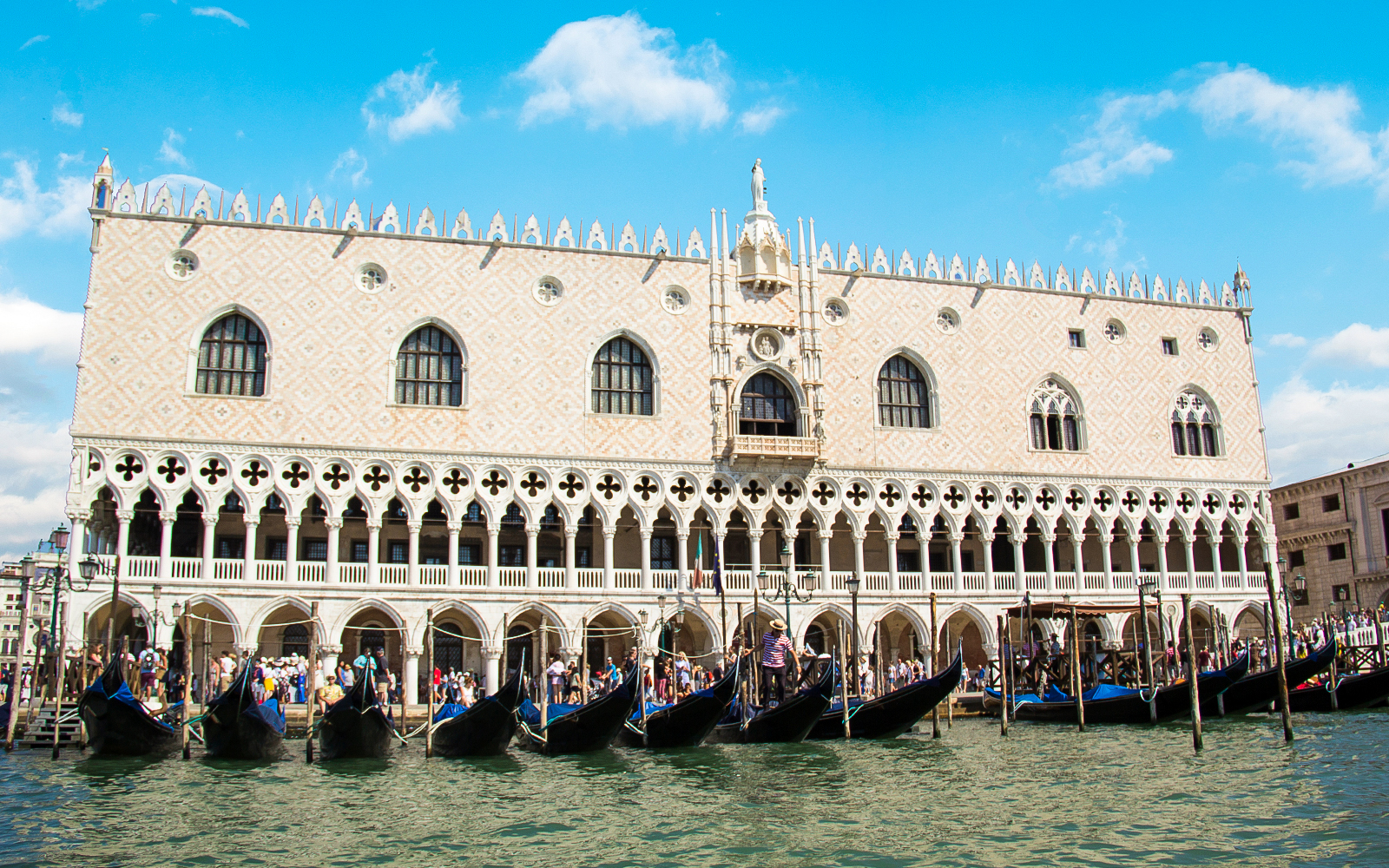
For 500 years the Palazzo Ducale was the power centre of the Venetian Republic — residence of the Doge, seat of the Great Council (Maggior Consiglio), the Senate, the ten-member state security commission (Consiglio dei Dieci) and the main court. Today’s building essentially dates from the 14th and 15th centuries; the striking Gothic façade with its alternating white Istrian stone and pink Verona marble was built between 1340 and 1424.
Architecturally unusual: the building stands on an open row of arcades rather than a massive base. This inversion — heavy upper storeys on seemingly fragile columns — has been considered prototypical of Venetian Gothic since Ruskin. Inside, the palazzo was largely repainted after a fire in 1577: many of today’s principal works (Tintoretto, Veronese, Bassano, Palma il Giovane) date from the late-Renaissance reconstruction phase.
With the end of the Republic in 1797 under Napoleon, its role as the seat of government also ended. After Austrian and Italian administrative use in the 19th century, the palazzo was fully converted into a museum in 1923. Today it belongs to the municipal MUVE museum network and is one of the most visited museums in Venice.
Tickets 2026: options, prices, combined passes
The standard Doge’s Palace ticket is sold as the ticket for the St Mark’s Square museums and covers, besides the Palazzo Ducale, the Museo Correr, the Archaeological Museum and the monumental rooms of the Biblioteca Marciana. The following figures are guide values (as of spring 2026) and can change by season and booking route — the official VisitMUVE site is authoritative.
| Ticket variant | What is included | Guide price 2026 (approx.) |
|---|---|---|
| Combined St Mark’s Square ticket (standard) | Doge’s Palace + Museo Correr + Archaeological Museum + Marciana Library | regular approx. €35, online partly from €30 |
| Itinerari Segreti (“Secret Itineraries”) | Guided tour of approx. 75 min through administrative, judicial and prison areas + standard route afterwards | approx. €40, advance booking required |
| MUVE Museum Pass | Several municipal museums (incl. Doge’s Palace, Correr, Ca’ Rezzonico, Fortuny and others) | approx. €50 |
| St Mark’s City Pass | Doge’s Palace + St Mark’s Basilica areas (Pala d’Oro, treasury) + further packages | varies by package |
| Skip-the-line online (third party) | Standard ticket with a guaranteed time slot, no queueing at the desk | from approx. €35–45 depending on provider |
Reductions: children under 6 usually free, ages 6–14 reduced, students up to 25 reduced with ID. Check exact rates and languages on VisitMUVE before booking.
Audio guide: available at the ticket desk for a surcharge of about €5, in several languages including English.
Compare Doge’s Palace tickets online
Which ticket variant suits whom?
Standard combined ticket — for most first-time visitors
The normal combined ticket is the right choice for most travellers visiting Venice once or twice. The route through the palazzo takes 2–3 hours; the Museo Correr on the same ticket adds another 60–90 minutes. The entrance queue is usually manageable in the shoulder season; in high season it can grow long at the desk.
Itinerari Segreti — for history lovers
The “Itinerari Segreti del Palazzo Ducale” are a guided special tour through rooms not accessible on the standard route: notaries’ offices, the secret chancellery, the inquisition room, a historic torture chamber, the lead chambers under the roof (Piombi — hence Casanova’s famous escape of 1756). The tour lasts about 75 minutes, is officially offered in English, Italian and French, and ends so that you can do the unguided standard route afterwards.
Advance booking required. Limited places per slot; in high season often booked out weeks ahead.
MUVE Museum Pass — for multi-day or repeat visitors
If you visit three or more municipal museums, the MUVE pass works out cheaper. Several venues are included — exact list and validity on VisitMUVE.
St Mark’s City Pass — if only St Mark’s Square interests you
Various packages bundle the Doge’s Palace with St Mark’s Basilica areas (Pala d’Oro, treasury, the Loggia dei Cavalli on the roof), sometimes also with the bell-tower ascent.
Highlights of the Doge’s Palace — what not to miss
1. Cortile (courtyard) and Scala dei Giganti
The wide courtyard shows the other side of the palazzo: facing inwards the building is more classical, with Sansovino’s statues of Mars and Neptune on the “Giants’ Staircase”. This is where the Doges were crowned after their election.
2. Scala d’Oro (Golden Staircase)
The ascent to the state rooms. Gilded stucco ceiling, frescoes by Battista Franco. Anyone who climbed these stairs was a patrician.
3. Anticollegio and Sala del Collegio
Antechamber and meeting room of the governing committee. In the Anticollegio: four principal works by Tintoretto, the Bacchus and Ariadne allegory, and Veronese’s “Rape of Europa”.
4. Sala del Senato
The Senate’s meeting hall (about 200 members in the 16th century). Ceiling and walls by Tintoretto and his school.
5. Sala del Consiglio dei Dieci and Sala della Bussola
Meeting hall of the notorious Council of Ten. In the adjoining Sala della Bussola, the famous “Bocca di Leone” — the lion’s-mouth letterbox for anonymous denunciations.
6. Sala del Maggior Consiglio — the largest hall
53 metres long, 25 metres wide, without a single supporting column. On the end wall, Tintoretto’s “Paradiso” — more than 22 metres wide, one of the largest oil paintings in the world. Around the walls runs the portrait gallery of all 76 Doges — one spot is covered with a black cloth: Doge Marin Falier, executed for high treason in 1355.
7. Sala dello Scrutinio
The Great Council’s counting hall. Here too a continuous gallery of Doge portraits and large-format battle paintings, including Andrea Vicentino’s “Battle of Lepanto” (1571).
8. Bridge of Sighs and the New Prisons
The famous Ponte dei Sospiri connects the palazzo with the new prisons (Prigioni Nuove, built from 1600) across the Rio di Palazzo. → Our dedicated Bridge of Sighs page.
9. Armeria (armoury)
Four rooms with the weapons and armour collection of the Council of Ten — swords, halberds, maces and firearms from the 14th to the 18th century.
Itinerari Segreti — the secret tour
The “secret itineraries” show the palazzo as an administrative machine and place of justice, not as a stage for display. A limited group per slot is guided up narrow wooden staircases into rooms the standard route never touches:
- Sala dell’Avogador di Comun — the Republic’s notary office
- Secret chancellery (Cancelleria Segreta) — wall cabinets full of diplomatic reports
- Sala della Tortura (torture chamber) — a small room with the rope pulley for the “corda” torture
- Pozzi (wells) — prison cells on the ground floor, just above the waterline
- Piombi (lead chambers) — cells under the lead roof; Casanova was imprisoned here in 1755 and escaped in 1756
Opening hours and the best time to visit
| Season | Opening hours | Last entry |
|---|---|---|
| 1 April – 31 October | 9:00 – 19:00 | usually 1 hour before closing |
| 1 November – 31 March | 9:00 – 18:00 | usually 1 hour before closing |
| 25 December + 1 January | usually closed | – |
Best time of day: the first slot (9:00–10:30) — noticeably quieter, good light. Full tour groups at midday. Late afternoon (from 16:00) quieter again. If you want to book the Itinerari Segreti, reserve early as places are limited.
Getting to the Doge’s Palace
The entrance is at the south-western end of St Mark’s Square, at the Porta del Frumento (water side), address Piazza San Marco 1, 30124 Venezia.
- Vaporetto line 1, line 2, line 5.1/5.2: San Zaccaria stop (3 min on foot)
- Vaporetto line 1, line 2: San Marco — Vallaresso (4 min)
- From Marco Polo Airport: Alilaguna directly to San Marco, or bus to Piazzale Roma + vaporetto
The Doge’s Palace during acqua alta
The entrance area lies only about 100 metres from the lowest point of St Mark’s Square — at higher water levels the forecourt can flood and the regular entrance may close temporarily or be routed over raised walkways. Whether your visit is affected depends on the actual level and the protective measures in place. The interiors are on the first floor and above and stay dry. Live status on our acqua alta page with live tide levels.
With children, and accessibility
The Doge’s Palace works well for children from about 8 years — the monumental halls, the armoury and the prison rooms have a high wow factor. The palazzo is largely accessible; a lift connects the levels. For current accessibility information see the official VisitMUVE site.
Guided tours
A guided tour is particularly worthwhile in the Doge’s Palace, because without explanation many halls register only as sumptuous wall surfaces. Doge’s Palace tours and skip-the-line tickets — partly combined with St Mark’s Basilica — are available from our affiliate partner GetYourGuide:
Frequently asked questions about the Doge’s Palace
How long does a visit to the Doge’s Palace take?
The standard route takes 2–3 hours if you allow time for Tintoretto’s “Paradiso” in the Maggior Consiglio, the Sala del Senato and the armoury. The Museo Correr (included in the same combined ticket) adds another 60–90 minutes. If you do the Itinerari Segreti, plan an additional 75 minutes — the special tour takes place before the normal route, so you spend around 4 hours in the palazzo in one go. First-time visitors should plan half a day.
Do I need a skip-the-line ticket for the Doge’s Palace?
In high season (June–August, Carnival weeks, Easter, holiday weekends) skip-the-line usually makes sense — the queue at the desk can get long. In low season (November–March, except Carnival) the wait is usually manageable; the standard ticket on site is often enough. If you travel with children or have a fixed day plan, advance booking is more relaxed even in low season. Skip-the-line online tickets start at about €35–45 from third parties such as GetYourGuide or Viator.
What is the difference between the standard route and the Itinerari Segreti?
The standard route leads through the state rooms — Golden Staircase, Maggior Consiglio, Senato, Anticollegio, armoury, Bridge of Sighs. It is the official stage of the Venetian state. The Itinerari Segreti (“secret itineraries”) are an additionally booked guided tour through the administrative and judicial rooms behind the scenes: notary office, secret chancellery, inquisition office, a historic torture chamber, the Pozzi prison on the ground floor and the Piombi lead chambers under the roof — where Casanova was held in 1755 and escaped in 1756. The special tour lasts 75 minutes, has limited places and is the more impressive part for many visitors. Advance booking required.
Is the Itinerari Segreti tour available in English?
Yes — the tour is officially offered in English, Italian and French, usually with several slots a day in each language. The official MUVE tour is detailed in its art history. Tours in other languages are mostly run by third parties such as GetYourGuide or Viator and are more reliably available in high season than in low season.
Can I buy tickets on site at the desk?
Yes, the ticket desk is in the entrance area on St Mark’s Square. In high season (June–August, Carnival, Easter) the queue can get long — then online pre-booking pays off. In low season the wait is usually short. Note: last entry is about one hour before closing, and the desk stops selling slightly earlier. If you arrive spontaneously in the late afternoon, keep the last entry in mind.
Is the audio guide worth it?
Yes, the official audio guide is a solid investment at about €5 extra at the ticket desk. It explains the political function of the individual halls (why was there a Council of Ten? how was the Doge elected?), the most important paintings (Tintoretto, Veronese, Bassano) and Venice’s historic role as a trading republic. Available in English and well produced. If you prefer a guided tour you can skip it — but for independent visitors the audio guide is very helpful, because many rooms register only as sumptuous wall surfaces without explanation.
Is the Doge’s Palace accessible during acqua alta?
At lower levels usually without restrictions — the entrance is slightly raised. At higher levels the regular entrance can close temporarily or be reachable only via raised walkways; in very high events the palazzo is sometimes closed entirely. The interiors are all on the first floor and above and stay dry even then. Whether your visit is affected depends on the actual level and the protective measures. Check the current situation on the acqua alta page with live tide levels. Tip: the Doge’s Palace is a good bad-weather alternative — 3 hours of dry indoor programme.
What is included in the combined ticket?
The standard combined St Mark’s Square ticket includes four venues: the Doge’s Palace (Palazzo Ducale), the Museo Correr (city history on St Mark’s Square), the Archaeological Museum (in the Correr building) and the monumental rooms of the Biblioteca Nazionale Marciana. The ticket is valid for several months and costs about €35 regular (online partly from €30) for adults. You do not have to visit the venues on the same day — many visitors do the Doge’s Palace and Correr on one day, the Marciana and Archaeological Museum on another. Audio guide about €5 extra.
Which ticket pays off for several days in Venice?
The MUVE Museum Pass — it covers several municipal museums and is valid for several months. From three visited venues it is cheaper than single tickets. The pass includes, among others, the Doge’s Palace, Museo Correr, Ca’ Rezzonico (Settecento palazzo), Palazzo Fortuny, Casa Goldoni and the glass museum on Murano. For a first trip focused on St Mark’s Square the standard combined ticket is enough; for a 5–7-day art trip MUVE pays off.
Related topics
- Architecture in Venice — Venetian Gothic, arcades instead of a base, Istria–Verona banding
- The Doges of Venice — election, residence, burials
- Art in Venice — Titian, Tintoretto, Veronese, Palladio, Bellini
- Churches & art in Venice — the 12 most important sacred buildings
- Venice access fee 2026 — Contributo di Accesso (calendar, €5/€10)
- Bridge of Sighs — right next to the Doge’s Palace
- Museums in Venice — overview and passes
- Venice sights — the 12 most important places
- Museo Correr — on the same combined ticket
- Gallerie dell’Accademia — Venetian painting
- St Mark’s Square — right in front of the Doge’s Palace
- St Mark’s Basilica — the building opposite
- Acqua alta — live tide levels and accessibility
- Getting to Venice + vaporetto